
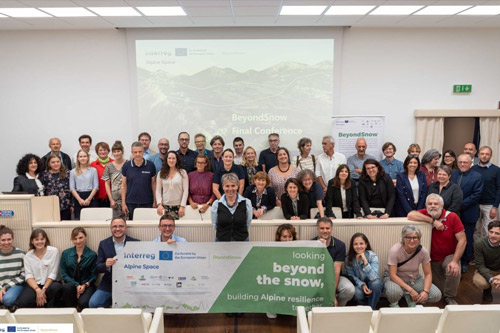
The BeyondSnow – Interreg Alpine Space project officially concluded with its Final Conference in Turin, marking the end of a three-year collaboration among 13 partners from six Alpine countries. The event, hosted by Città metropolitana di Torino and the Piedmont Region, provided a platform to present the project’s key outcomes and tools designed to support Alpine communities in adapting to climate change.
Final Conference: From Collaboration to Concrete Tools
The closing conference brought together experts, policymakers, tourism stakeholders, and local authorities to review the project’s achievements and explore pathways for continued implementation.
Key highlights included:
-
A detailed presentation of the project’s scientific approach, methodology, and findings from a three-year research and implementation cycle
-
- Launch and demonstration of four core tools developed under the project:
- Vulnerability Map of Alpine Snow Tourism Destinations – covering 32 selected destinations across the Alpine region
- Climate Resilience Digital Tool – an interactive platform for assessing climate risks and testing adaptation scenarios
- Resilience Adaptation Model (RAM) – a framework for strategic planning and decision-making in tourism destinations
- 10 Transition Strategies & Policy Guidelines – evidence-based recommendations for diversifying tourism and strengthening resilience
-
Presentation of pilot actions implemented
-
Interactive sessions and co-creation workshops with local communities to test tools and gather feedback
-
Official launch of the project’s final report, communication toolkit, and open-access digital platform
The event underscored that while the formal project period ends in October 2025, the journey toward climate resilience in Alpine tourism continues.
Project Overview
The BeyondSnow – Interreg Alpine Space project was co-funded by the European Regional Development Fund (ERDF) under the Interreg Alpine Space programme. Led by Eurac Research (Italy) and with Legambiente Lombardia as the communications lead partner, the initiative brought together 13 partners from six Alpine countries over a three-year period to address the growing challenges of climate change for mountain tourism.
The consortium included:
-
Politecnico di Torino (Italy)
-
Carnia Mountain Community (Italy)
-
Razvojna agencija Zgornje Gorenjske (Slovenia)
-
Arctur / Tourism 4.0 (Slovenia)
-
Deggendorf Institute of Technology (Germany)
-
Syndicat Mixte du Mont d’Or – Station de Métabief (France)
-
Schweizerische Arbeitsgemeinschaft für die Berggebiete (Switzerland)
-
Alliance in the Alps
-
La Fabrique des Transitions (France)
-
Alpine Pearls
-
European Campus Rottal-Inn EGTC
The project focused on enabling Alpine communities to build long-term resilience through innovative digital tools, evidence-based strategic planning, and transnational cooperation. With a strong emphasis on sustainable diversification of tourism, the initiative supported destinations in moving beyond snow-dependent models, promoting year-round economic vitality, and strengthening environmental stewardship.
By integrating climate risk assessment, digital innovation, and community engagement, BeyondSnow delivered practical solutions — including the Vulnerability Map, Climate Resilience Tool, Resilience Adaptation Model (RAM) and 10 Transition Strategies— that are now available for immediate use by regional planners, tourism boards, and local authorities across the Alpine region.