
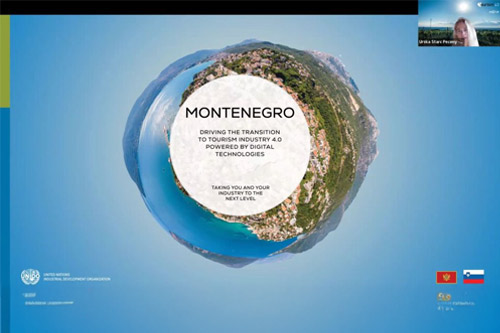
The Tourism 4.0 vision is expanding across the Western Balkans, with the launch of the Training Programme “Digital Innovation of Cultural Heritage” in Montenegro.
Organized as part of the project “Provision of Digital Technologies Fostering Tourism 4.0 and Technological Learning in Montenegro”, the initiative is implemented in cooperation with UNIDO, the Ministry of Tourism of Montenegro, and Arctur. The programme marks a key step in supporting Montenegro’s digital transformation in tourism through knowledge exchange and technological capacity building.
Launch of the Workshop Series
The first workshop of the “Digital Innovation of Cultural Heritage” training series, led by Urska Starc Peceny and Matevž Straus from Arctur, introduced participants to core concepts in 3D digitalization, artificial intelligence (AI), and immersive storytelling. The session focused on practical applications of these technologies in the context of cultural heritage preservation and promotion.
Participants explored how 3D digitalization — using photogrammetry and laser scanning — enables high-accuracy documentation of historical sites, artifacts, and architectural details. This digital record supports long-term conservation, virtual reconstruction, and accessible online presentation of heritage assets, especially for vulnerable or remote locations.
The training also covered AI-driven tools for automating data processing, such as object recognition in 3D point clouds, metadata generation, and content classification. These capabilities reduce manual workload and improve the efficiency of managing large digital heritage collections.
Finally, the workshop demonstrated how immersive storytelling — using 3D models in AR/VR experiences, interactive websites, and mobile applications — can enhance visitor engagement. By integrating narrative content with spatial data, cultural heritage becomes more accessible, emotionally resonant, and inclusive — particularly for younger audiences, people with disabilities, and international visitors.
The training is part of a broader knowledge transfer initiative, bringing practical expertise and methodologies developed in Slovenia’s Tourism 4.0 ecosystem to Montenegro. The goal is to strengthen local capacity in digital innovation, support the sustainable development of cultural tourism, and enable heritage institutions and tourism professionals to leverage technology for better preservation, communication, and visitor experience.
Programme Structure: Theory, Practice, and Real-World Application
The five-part training series combines online, hybrid, and on-site sessions, ensuring broad accessibility while enabling hands-on learning and direct engagement with real-world applications. This blended format allows participants to build theoretical knowledge, apply skills in practical exercises, and benefit from face-to-face collaboration in the final on-site workshop.
Upcoming Workshops:
-
3D Digital Capture and Data Processing – 17 November 2025
-
Principles of Digital Storytelling with 3D Assets – 24 November 2025
-
3D Data Management – 1 December 2025
-
Hands-on Workshop (on-site) – June 2026 (location to be confirmed)
Participants include professionals from cultural institutions, tourism boards, local authorities, and heritage preservation organizations — all aiming to strengthen their digital competencies and contribute to a more innovative, sustainable, and inclusive tourism sector in Montenegro.
Project Background
The project is implemented under UNIDO’s Technical Cooperation Programme, with support from the Ministry of Tourism of Montenegro and Arctur — a Slovenian innovation partner with proven expertise in digital heritage and Tourism 4.0. It enables targeted knowledge transfer from Slovenia to Montenegro, building local capacity in 3D digitalization, AI, and immersive storytelling for cultural heritage.
This initiative supports Montenegro’s digital transformation in tourism by strengthening institutional competencies, promoting sustainable heritage management, and fostering innovation in the sector — aligning with national strategies for digitalisation, cultural preservation, and inclusive growth.
Read more about the planned workshops within the project.